Oat Milk Smoothie Recipes: How to Use Oat Milk in Smoothies
Oat milk has quietly become the default plant milk in a lot of UK kitchens, and for smoothies it might be the best one yet. It blends into a properly creamy base without the faint bean-y edge some other plant milks have, and it plays nicely with frozen fruit instead of turning icy and separated. Here’s how to actually use it well, plus a handful of blends to try once you’ve got the base sorted.
As an Amazon Associate, I earn from qualifying purchases and sometimes recommend products from other sellers at no extra cost to you. For more details see my disclosure policy and privacy policy.
🌾 Why Oat Milk Works So Well In Smoothies
Oat milk has a naturally creamy body, closer to whole dairy milk than most other plant milks manage, which means your smoothie holds its texture instead of turning watery. It also carries a mild, slightly sweet flavour of its own, so a smoothie made with it needs less added sweetener than one made with water or a more neutral milk.
That combination, body plus a touch of natural sweetness, is why oat milk shows up so often in cafe-style smoothies. It’s doing real work in the glass rather than just being a liquid to blend everything else in.
🥛 How It Compares To Dairy, Almond And Soy
- Dairy milk is creamier still and has more protein, but it’s obviously not an option for anyone avoiding dairy, and it can taste heavier in fruit-forward blends.
- Almond milk is thinner and more watery than oat milk, and it has a distinct nutty flavour that can compete with delicate fruit. It also tends to separate more visibly if a smoothie sits for a few minutes.
- Soy milk is closer to oat milk in protein content, but has a more noticeable bean-y taste that some people pick up on straight away, especially in a lighter, fruit-based smoothie.
- Oat milk sits in the middle: creamy enough to carry the smoothie, neutral enough not to fight with the fruit, and it holds up well once frozen fruit goes into the blender rather than thinning out.
If you want the fuller picture on milk options generally, our guide to using milk in smoothies covers dairy and the full range of alternatives side by side. And if dairy-free is the whole point for you, how to make a dairy-free smoothie is worth a read too, since oat milk is only one of several routes in.
📐 The Base Formula
Once you’ve got a feel for the ratio, you can build almost any oat milk smoothie without measuring again.
- Liquid: 200-250ml oat milk per serving is a good starting point.
- Frozen element: a handful (roughly 150g) of frozen fruit, or a frozen banana, gives you that thick, cold, milkshake-style texture without needing ice, which would only water things down.
- Fresh or extra fruit: 50-100g on top of the frozen fruit adds brightness and natural sweetness.
- Add-ins: a tablespoon of nut butter, a scoop of protein powder, or a spoonful of oats, whichever suits the blend.
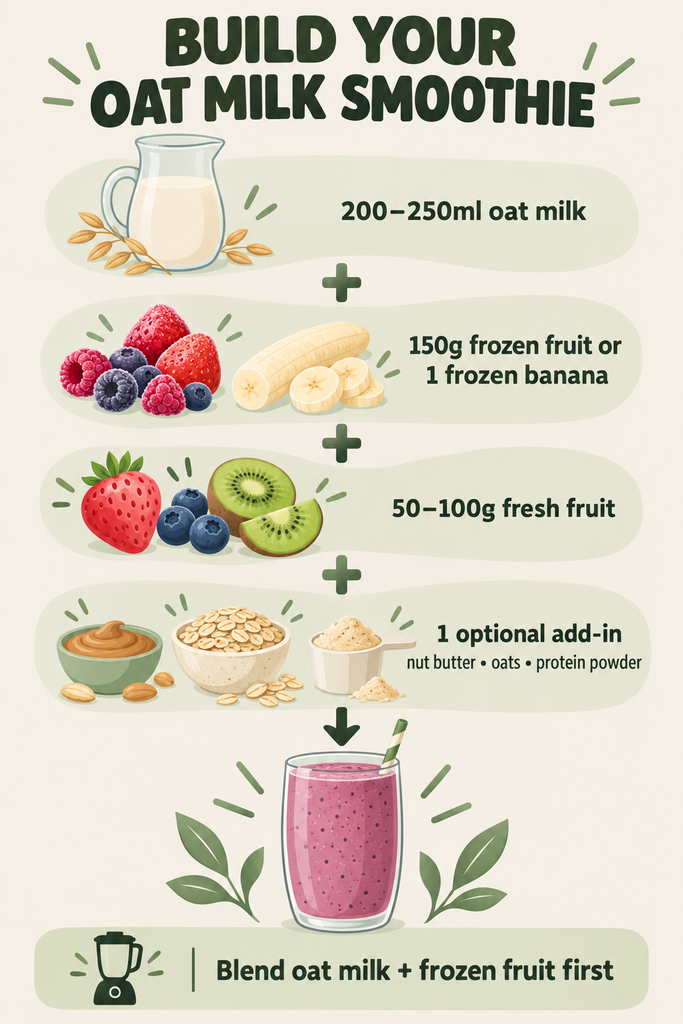
Blend the oat milk and frozen fruit first for about twenty seconds, then add everything else and blend again until smooth. If it’s thicker than you’d like, add a splash more oat milk, a tablespoon at a time, rather than a big glug that thins it too far.
🍓 Five Blends To Try
Classic Fruit: 200ml oat milk, 150g frozen mixed berries, half a banana. Blend until smooth. Simple, reliably good, and the one to start with if you’re new to oat milk smoothies.
Green: 200ml oat milk, a handful of spinach, 100g frozen mango, half a banana. The mango’s sweetness carries the spinach so it doesn’t taste like a chore.
Chocolate Peanut Butter: 220ml oat milk, one frozen banana, a tablespoon of peanut butter, a tablespoon of cocoa powder. Genuinely tastes like a dessert, and the oat milk’s own sweetness means you barely need to add any extra.
Breakfast: 200ml oat milk, 100g frozen berries, a tablespoon of oats, a scoop of your usual plant protein blend. Filling enough to genuinely replace breakfast rather than just delay hunger by twenty minutes.
Vanilla Oat Milkshake: 220ml oat milk, one frozen banana, half a teaspoon of vanilla extract, a pinch of cinnamon. The closest this list gets to a treat, and a good one for using up a banana that’s gone a bit too ripe for eating plain.
🛒 Buying Tips: What To Look For
Not all oat milk is built the same way, and for smoothies it’s worth knowing the difference before you buy.
Barista vs standard: barista-style oat milk is formulated with a bit more fat and protein specifically so it foams and holds body in hot drinks, and that same extra body makes it noticeably creamier in a smoothie too. Standard oat milk is thinner and works fine, but you may want to use slightly less liquid overall to compensate.
Sweetened vs unsweetened: unsweetened is the better starting point for smoothies, since you’re usually adding naturally sweet fruit anyway, and it lets you control sweetness yourself rather than stacking two sources of sugar on top of each other.
UK brands to look for: Oatly, Alpro, Minor Figures and Moma are all widely stocked across the major UK supermarkets, alongside solid own-brand versions from Aldi and Morrisons that regularly perform just as well in taste tests despite costing less. If you want a specific place to start, Oatly’s barista-style oat drink is a reliable, easy-to-find option for smoothies as well as coffee.
Making your own: blending 100g rolled oats with 1 litre of water, straining through a nut milk bag, is a cheap and simple option if you’d rather skip the packaging, though it will be thinner than shop-bought barista versions unless you reduce the water slightly.
🔧 Common Problems (And How To Fix Them)
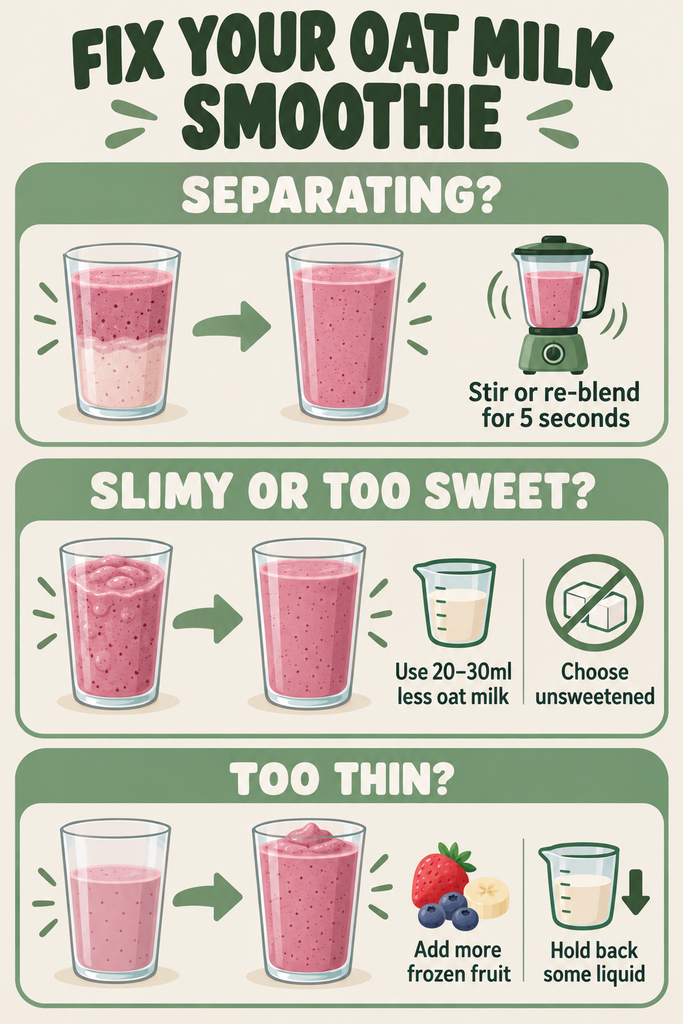
Separating: oat milk smoothies can separate a little if they sit for more than ten or fifteen minutes, since there’s no stabiliser doing the job a dairy product’s fat would. A quick stir or a five-second re-blend brings it straight back together, so it’s not a sign anything’s gone wrong.
Slimy or over-sweet texture: this is almost always down to using too much oat milk relative to fruit, or using a sweetened variety on top of already-sweet fruit. Cut the oat milk back by 20-30ml and swap to unsweetened if that’s the issue.
Too thin: either not enough frozen fruit, or oat milk added too fast. Add your frozen fruit in stages rather than all the liquid up front, and hold back a splash of oat milk until you’ve seen how thick the blend already is.
If texture issues keep cropping up no matter what you try, our general guide to fixing smoothie texture problems covers a wider range of causes beyond just the milk itself, and it’s worth a read if oat milk isn’t the only variable at play.
🧊 Make-Ahead And Freezer Tips
Oat milk smoothies are a good candidate for prepping ahead, provided you’re a little careful about how.
Pre-portion your frozen fruit and any dry add-ins (oats, protein powder) into reusable freezer bags so a bag comes straight out of the freezer and into the blender each morning, with only the oat milk needing to be added fresh. This keeps the fruit properly frozen for a good texture and stops the oat milk sitting around going slightly stale in the fridge for days at a time.
Avoid freezing oat milk itself if you can help it. It tends to separate more than dairy does once thawed, and while a good blend will mostly bring it back together, it’s simpler to just add it fresh each time your frozen fruit pack comes out.
❓ Common Questions
Can I use oat milk in a smoothie bowl instead of a drink? Yes, and it actually works particularly well there. Use slightly less oat milk than you would for a drinkable smoothie (150-180ml rather than 200-250ml) so the result is thick enough to eat with a spoon and hold toppings on the surface.
Does oat milk change the flavour of the fruit? Barely, and that’s part of the appeal. Oat milk’s mild, slightly sweet flavour sits behind the fruit rather than competing with it, unlike a strongly flavoured nut milk.
Is oat milk suitable if I’m avoiding gluten? Oats themselves are naturally gluten-free, but they’re often processed alongside wheat, so check the carton for a “gluten-free” certification if that matters to you, rather than assuming all oat milk automatically qualifies.
Can I mix oat milk with another plant milk? Yes. A half-and-half mix with almond milk, for example, gives you oat milk’s creaminess with a lighter overall result, which is worth trying if you find straight oat milk a little heavy for your taste.
🌟 Making Oat Milk Your Everyday Smoothie Base
Oat milk earns its place as a smoothie base through what it actually does in the glass: real body, a touch of natural sweetness, and a texture that holds up once frozen fruit gets involved. It’s not a substitute you settle for because dairy’s off the table. For a lot of blends, it’s simply the better choice.
Start with the base formula above, pick whichever of the five blends sounds best today, and adjust the ratio to your own taste from there. And if you’re shopping for a blender that can actually handle a frozen banana without complaint, our smoothie blender buying guide walks through budget, mid-range and investment options so you’re not guessing.