Post-Workout Smoothie Recipes: The Complete Roundup
You’ve just finished a workout, you’re starving, and the last thing you want to do is overthink what happens next. A good post-workout smoothie solves that in under five minutes: blend it, drink it, get on with your day. Below are two Smoothie Bird favourites built exactly for this moment, plus everything you need to know about choosing (or tweaking) the right one for you.
As an Amazon Associate, I earn from qualifying purchases and sometimes recommend products from other sellers at no extra cost to you. For more details see my disclosure policy and privacy policy.
What Actually Makes a Smoothie “Post-Workout”
It’s not magic, and it’s not about hitting some tiny window of time. It’s really just protein and carbs, in a form your body can use quickly after training.
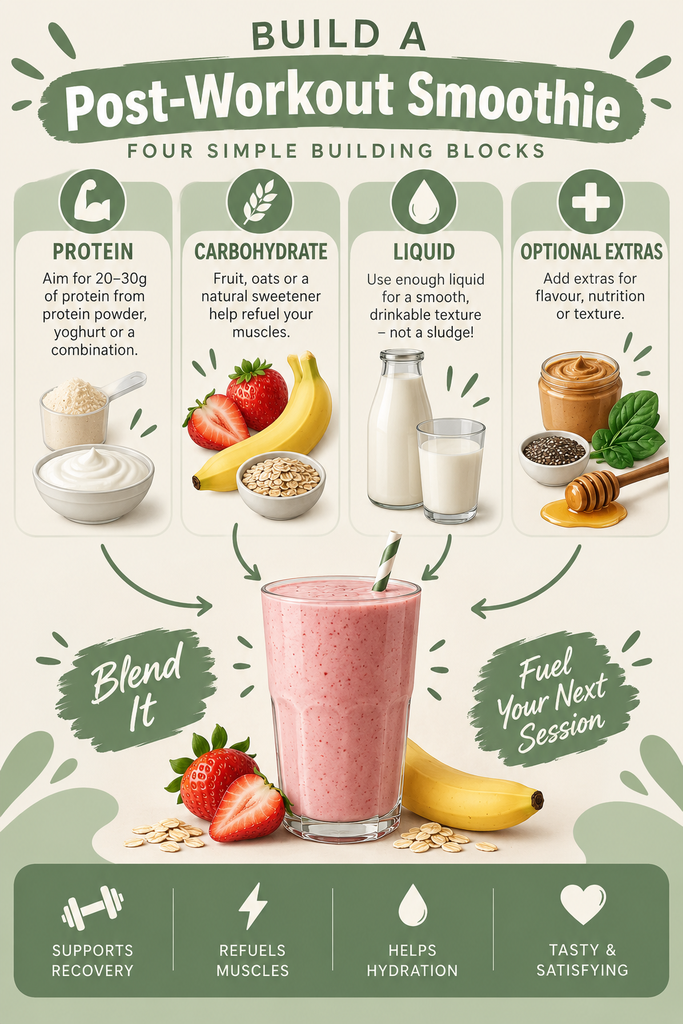
Most guidance points to somewhere around 20-30g of protein after a workout, alongside some carbohydrate to help refuel the muscles you’ve just used. That’s a realistic target for a smoothie, not an extreme one, and both recipes below land comfortably in that range once you add a scoop of protein powder.
You also don’t need to panic about drinking it the second you put your weights down. The idea of a strict “anabolic window” that closes within minutes of finishing exercise has been walked back by more recent research, which points to total daily protein intake mattering far more than split-second timing. Having your smoothie within an hour or two of training is a sensible habit, not a race against the clock.
Hydration matters here too, even though it’s easy to overlook. A smoothie already carries a good amount of fluid, but if you’ve trained hard and sweated a lot, it’s worth having a glass of water alongside it rather than treating the smoothie as your only source of rehydration.
Carbohydrate is easy to overlook when protein gets all the attention, but it plays its own role. Fruit, oats, or even a spoon of honey help top up the energy stores your muscles just used, which is part of why a smoothie works better here than a protein shake made with water alone.
A few things worth aiming for in any post-workout blend:
- Protein: roughly 20-30g, from protein powder, yoghurt, or a combination
- Carbohydrate: fruit, oats, or a natural sweetener to help refuel
- Liquid: enough to get a smooth, drinkable texture, not a sludge you have to chew
- Timing: somewhere in the hour or two after training, without stressing over the exact minute
How This Differs From an Everyday Smoothie
Both recipes in this roundup could pass as a regular fruit smoothie if you skipped the protein powder, and that’s kind of the point. What tips a smoothie into “post-workout” territory isn’t a special ingredient list, it’s the ratio. A regular breakfast smoothie might be fruit-heavy and light on protein, which is fine for a snack but leaves you hungry again quickly after a hard session.
Bumping the protein up to that 20-30g range, and keeping some carbohydrate alongside it, is really the only adjustment that matters. You don’t need specialist “sports nutrition” ingredients to get there. A normal protein powder, some fruit, and a liquid base will do the job just as well as anything marketed specifically for athletes.
What You’ll Need
Both recipes below come together with basic kitchen kit: measuring spoons, your usual smoothie add-ins, and a blender powerful enough to break down frozen fruit and ice without turning into a chunky mess. If your current blender struggles with frozen fruit, that’s usually the first thing worth upgrading before anything else.
It’s also worth keeping a stash of pre-portioned frozen fruit in the freezer if you train regularly. Having your fruit already measured out and frozen means the whole process, from finishing your workout to having a smoothie in hand, takes less than five minutes.
The Recipes
These two recipes already live on Smoothie Bird, and they’re the ones we reach for most after a session. Full ingredient lists and step-by-step instructions are on their own pages, so head there for the exact method.
Strawberry Protein Post-Workout Smoothie
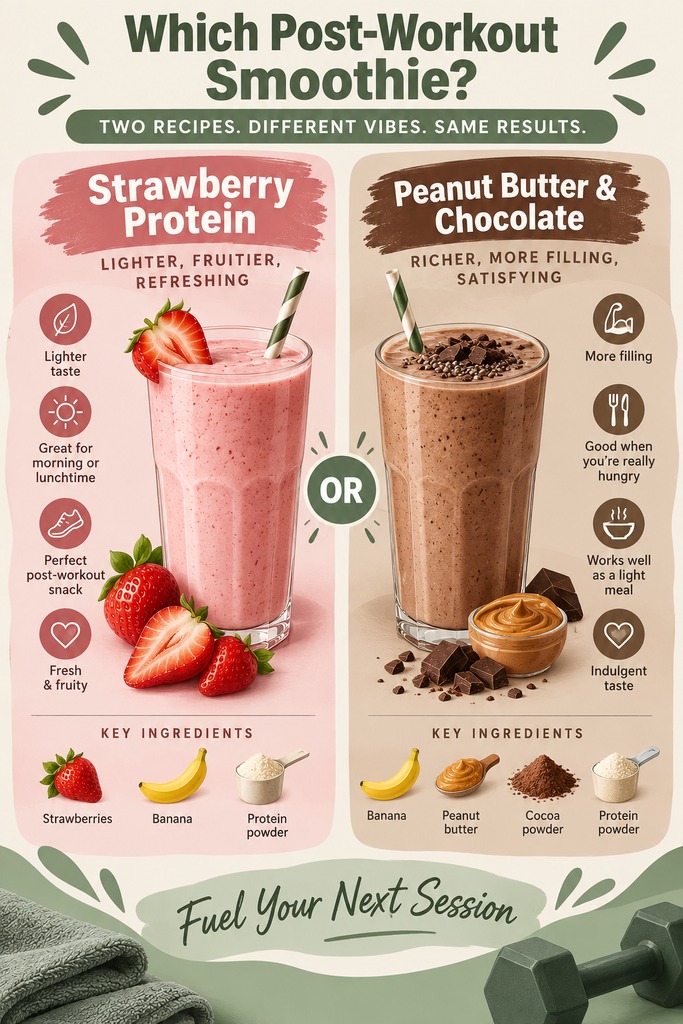
This is the lighter, fruitier option. It leans on strawberries and a scoop of protein powder for a smoothie that tastes more like a treat than a chore, while still landing in that useful post-workout protein range. It blends up bright pink, tastes clean and fresh, and doesn’t sit heavy if you’ve trained first thing in the morning or squeezed a session in on a lunch break.
Get the full recipe here: Strawberry Protein Post Workout Smoothie
Peanut Butter and Chocolate Post-Workout Smoothie
This one is the richer, more filling option, built for when a workout has left you properly hungry. Peanut butter and cocoa give it a milkshake-like texture and flavour, and it works well as a stand-in for a proper meal if you’ve trained somewhere you can’t cook straight afterwards, like a gym session before work or an evening class that runs late.
Get the full recipe here: Peanut Butter and Chocolate Post-Workout Smoothie
Which One Should You Make?
If you’re not sure where to start, this usually comes down to two things: how hungry you are, and what mood you’re in.
- Go for the strawberry version if: you want something lighter and more refreshing, you’ve trained in the morning, or you’d rather not feel too full before getting on with your day
- Go for the peanut butter and chocolate version if: you’re genuinely hungry after training, you want something that can double as a light meal, or you’re after a dessert-style treat that still does a job nutritionally
Neither one is the “better” choice. They’re built for different moods, which is exactly why we keep both in rotation rather than picking a single “best” post-workout smoothie.
Easy Ways to Customize Either Recipe
Both recipes are easy to adjust depending on what you’ve got in the kitchen or what you need from your smoothie that day.
Swap the protein powder. Both recipes work with whichever protein powder you already use. A whey protein that mixes smoothly into cold liquid without going gritty is a solid, affordable everyday option. If you’re after more detail on choosing between whey blends, our guide to the best protein powder for smoothies covers flavour, mixability, and price side by side.
Make it dairy-free. Swap dairy milk or yoghurt for a plant-based alternative, and swap in a plant-based protein blend that holds up well in fruit smoothies instead of a whey powder. For more swaps beyond the protein itself, our dairy-free smoothie guide walks through milk, yoghurt, and creaminess alternatives.
No protein powder on hand? You can still get a decent amount of protein into either smoothie using Greek yoghurt, milk, or nut butter instead. Our guide on adding protein to a smoothie without powder has ten practical ways to do it.
Bulk it out. A handful of oats or half a banana added to either recipe will add more carbohydrate if you’ve trained hard and need something more substantial.
Sneak in extra nutrients. A small handful of spinach disappears completely into either recipe, especially the chocolate version, if you want to add some extra vegetables without changing the flavour much.
Post-Workout Smoothie FAQs
Do I have to drink it immediately after my workout?
No. While it’s a good habit to have your smoothie within a couple of hours of training, there’s no strict cut-off point where the benefit disappears. What you eat across the whole day matters more than the exact minute you drink this.
Can I make either smoothie ahead of time?
Yes, to a point. Both blend best fresh, but you can prep and freeze the fruit portions in advance so all that’s left to do post-workout is add your liquid and protein and blend. Our guide to freezer smoothie packs shows how to set this up.
Can I use a food processor instead of a blender?
For both of these, a high-powered blender will give you a smoother result, especially with frozen fruit. If a blender isn’t an option, our guide on making smoothies in a food processor explains what to expect and how to get the best texture.
Is a post-workout smoothie a meal replacement?
The peanut butter and chocolate version is filling enough to work as a light meal if that suits your schedule. The strawberry version is lighter and probably better as a snack alongside food rather than instead of it, especially if your workout was intense.
Can I drink one of these before a workout instead?
You can, though you may want to go lighter on the fruit and protein beforehand so you’re not training on a very full stomach. Both recipes were designed with after-training in mind, but there’s nothing stopping you from having a smaller portion pre-workout if that works better for your schedule.
More Post-Workout Recipes on the Way
This roundup will keep growing. As we add more post-workout smoothies to the site, we’ll fold them into this same page, so it’s worth bookmarking or pinning if this is a category you come back to often. For now, these two cover both ends of the spectrum, light and refreshing, or rich and filling, so you’ve got a solid starting point whichever kind of workout day you’ve had.


