Best Protein Powder for Smoothies (UK Guide 2026)
If your protein powder turns your smoothie into a chalky, clumpy mess, you’re using the wrong one. Not every powder that works fine in a shaker bottle survives being blitzed with frozen fruit and ice. This guide covers what actually matters for smoothie use, plus four UK picks that mix clean, taste good, and won’t leave grit stuck to your blender jug.
As an Amazon Associate, I earn from qualifying purchases and sometimes recommend products from other sellers at no extra cost to you. For more details see my disclosure policy and privacy policy.
This is purely a protein-focused guide. If you’re after greens, collagen or adaptogen powders instead, we’ve covered those separately in our smoothie powder supplements guide.
🔍 What Actually Matters for Smoothie Use
A smoothie is a rougher environment than a shaker bottle. Ice, frozen fruit and high-speed blending expose weaknesses that a gentle shake never would.
Here’s what to check before you buy:
- Mixability when blended, not shaken. Some powders that seem fine in water go gritty the second frozen banana and ice join the party.
- Flavour compatibility. A powder needs to complement your fruit and milk, not fight it. Vanilla and unflavoured are the safest smoothie bases.
- Sweetness level. Many smoothies already contain fruit, so an overly sweet powder can push the whole drink into dessert territory.
- Texture once blended. Powders with added fibre or gums can thicken a smoothie nicely, but too much turns it gluey.
If a powder ticks those boxes, it’s worth considering. If it only performs well in water, it’s not really a smoothie powder, whatever the label says.
🥛 Whey vs Plant-Based: Which Suits You?
Whey protein is the default for a reason. It dissolves fast, has a neutral-to-creamy taste, and blends smoothly even straight from the fridge. If you drink dairy without issue, whey is usually the easiest option for smoothies.
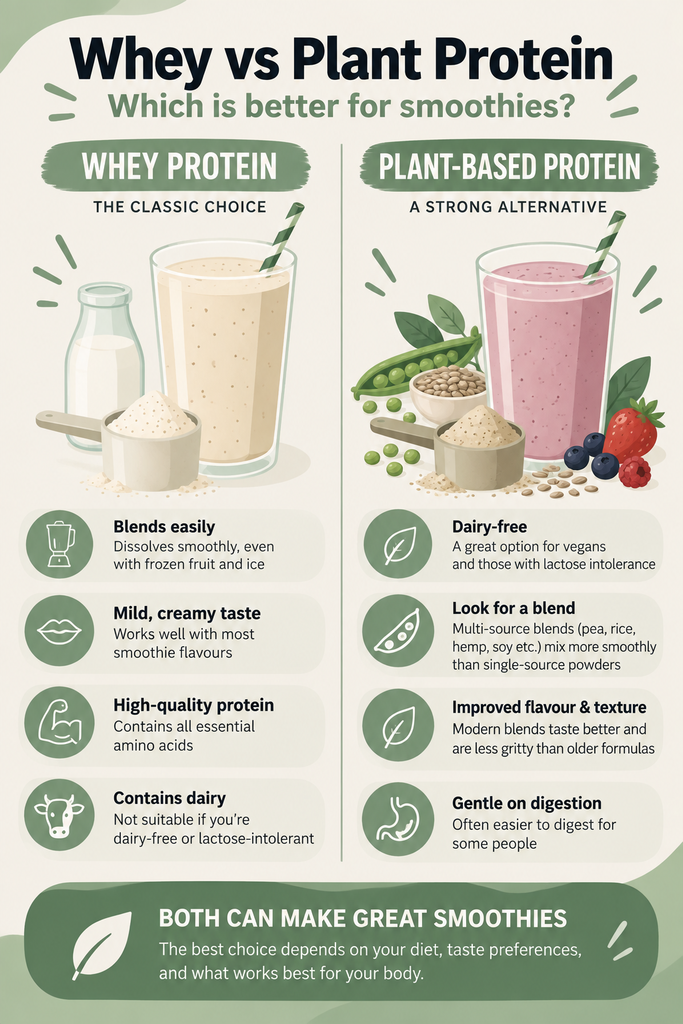
Plant-based protein has caught up a lot, but not all of it blends well. Pea protein isolate mixes far more smoothly than rice-only powders, which tend to leave a gritty finish once ice and frozen fruit are involved. The better vegan smoothie powders blend several plant proteins together specifically to avoid that problem.
If you’re dairy-free, lactose-intolerant, or simply prefer plant-based, look for a blend rather than a single-source powder. Single-source rice or pea powders on their own are the ones most likely to disappoint.
🧪 Concentrate vs Isolate: Does It Matter for Smoothies?
Whey concentrate and whey isolate are both fine for smoothies, but they behave slightly differently once blended. Concentrate has a touch more fat and lactose, which actually helps it blend into a smoothie with a creamier mouthfeel.
Isolate is stripped closer to pure protein, so it’s lighter and mixes thinner. It suits smoothies that already have a creamy base, like yoghurt or milk, but can taste watery in a fruit-only, dairy-free smoothie unless you add something to compensate.
For most people making everyday smoothies, concentrate is the easier choice. Isolate mainly earns its higher price if you’re strictly counting fat or lactose, not because it blends any better.
🏆 Best Overall: Myprotein Impact Whey Protein
Myprotein’s Impact Whey Protein is the easiest all-rounder to recommend for smoothies. It dissolves fast, comes in a genuinely huge range of flavours, and the vanilla and unflavoured versions barely alter the taste of whatever fruit you’re blending.
It’s also usually available at a strong price per serving once you factor in Myprotein’s frequent discount codes, which makes it easy to use generously without watching the tub disappear in a week.
Best for: anyone who eats dairy and wants a no-fuss, reliable option that just works.
💰 Best Budget: Bulk Pure Whey Protein
If you’d rather not chase discount codes, Bulk’s Pure Whey Protein is the steadier choice. The pricing barely moves, so what you see is roughly what you’ll pay, and the protein content is virtually identical to pricier options gram for gram.
It mixes cleanly in a blender and doesn’t have an overpowering flavour that fights with fruit, which is exactly what you want from a budget smoothie powder.
Best for: anyone who wants dependable pricing without hunting for sale codes.
🌱 Best Vegan: Protein Works Plant Protein Blend
Single-source vegan powders are the ones most likely to go gritty in a smoothie, so Protein Works’ plant protein blend is the safer pick. It combines pumpkin seed, pea, brown rice and soy protein rather than relying on one source, which is exactly why it blends more smoothly than most rice-only powders.
It holds up well against strong-flavoured fruit like mango or berries, without the chalkiness that puts a lot of people off plant-based protein.
Best for: vegans and dairy-free drinkers who’ve been put off plant protein by gritty texture in the past.
🎯 Best for Weight Loss / Lean Protein: Huel Complete Protein
Huel’s Complete Protein is worth calling out separately, because it isn’t a straight protein concentrate. It’s built to keep you fuller for longer alongside its protein content, which makes it a sensible pick if you’re using smoothies to manage weight or replace a meal rather than just topping up after a workout.
It blends well in a high-speed blender and works particularly nicely with banana and oats if you want a more filling, breakfast-style smoothie.
Best for: anyone using smoothies as a meal replacement or weight-management tool rather than pure post-workout recovery.
Want to see one of these in action? Our Banana Apple Protein Smoothie uses a single scoop of whey exactly the way we’d recommend here, so it’s a good place to start if you’re not sure how much to add.
🛒 UK Pricing and Availability
All four picks are widely available to UK buyers, either direct from the brand or through Amazon UK, so you’re not stuck waiting on international shipping or paying import charges.
Myprotein and Bulk both run frequent sales, and pricing can shift a lot depending on when you buy, so it’s worth checking current codes before assuming the sale price is the same as last month’s. Protein Works and Huel move less on price, which makes budgeting easier if you’d rather not track discount codes.
As a rough per-serving guide, budget and mid-range whey powders in the UK typically land somewhere between 40p and 90p per scoop depending on sales, while more specialised blends like vegan multi-protein mixes and meal-replacement style powders such as Huel tend to sit a little higher.
📏 How Much to Add (Without Ruining the Texture)
Most protein powders are built around a 25 to 30g serving, which is usually one scoop. That’s a sensible starting point for a single smoothie.
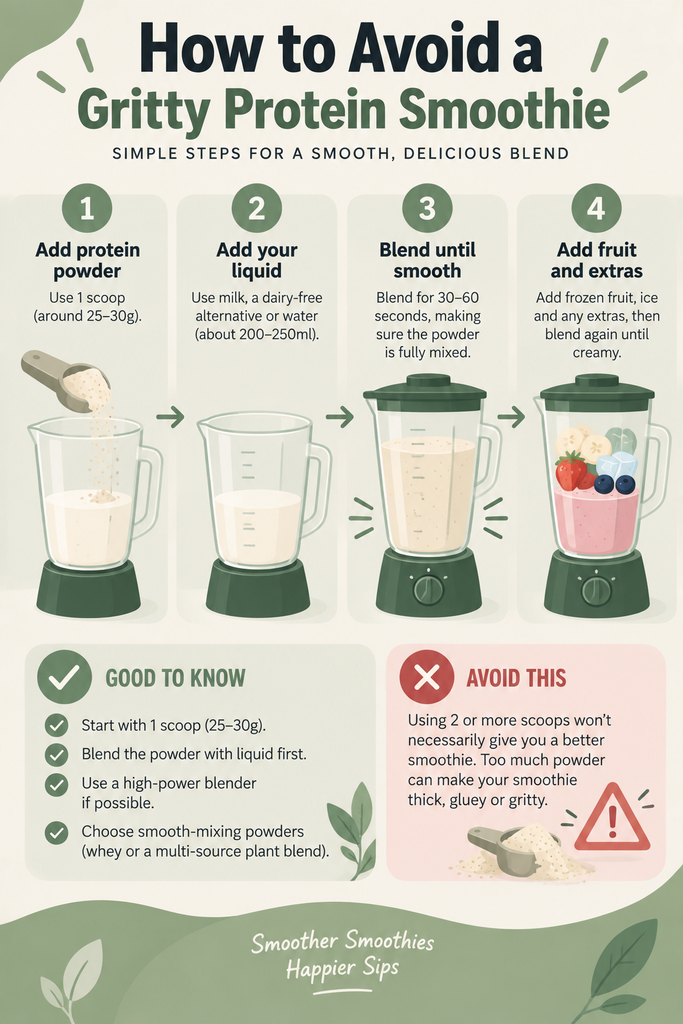
Adding more than that in one go is where texture problems start. Too much powder relative to liquid makes a smoothie gluey rather than creamy, and it can mute the fruit flavour you actually want to taste. If you’re chasing a higher protein total, it’s better to add a scoop of Greek yoghurt or extra milk alongside your usual scoop of powder than to double up on powder alone.
❓ FAQs
Can I just use any protein powder in a smoothie? You can, but not all of them are worth it. Powders built for shaking in water rather than blending can turn gritty or clumpy once ice and frozen fruit are involved, so it’s worth checking mixability specifically for blended drinks, not just for shakers.
Is whey or plant-based protein better for smoothies? Whey is generally easier to blend smoothly, especially straight from cold. Plant-based works well too, but only when it’s a multi-source blend rather than a single rice or pea powder on its own.
Will protein powder make my smoothie taste worse? Not if you pick the right one. Vanilla or unflavoured powders tend to sit in the background rather than fighting with your fruit, while heavily flavoured powders can clash, especially with berries or citrus.
How do I stop my protein smoothie going gritty? Choose a powder designed for blending rather than shaking, stick to one scoop per smoothie, and blend it into your liquid before adding ice. If grit is still showing up in your smoothies generally, not just with protein powder, it’s worth reading through common smoothie texture problems and how to fix them.
Can I use two scoops for extra protein? You can, but expect a thicker, gluier texture and a stronger flavour. If you want more protein without wrecking the texture, add a splash more liquid or a spoonful of Greek yoghurt alongside your usual scoop instead.
Quick Picks at a Glance
- Best overall: Myprotein Impact Whey Protein
- Best budget: Bulk Pure Whey Protein
- Best vegan: Protein Works Plant Protein Blend
- Best for weight loss/lean protein: Huel Complete Protein
Whichever you pick, the rule stays the same: one scoop, blended with your liquid before the ice goes in, and you’ll get a smoothie that tastes like fruit first and chalk never.


