Dairy-Free Smoothie Recipes Without Yogurt
Dairy-free smoothie recipes without yogurt can go wrong fast. You leave out the tub, and what comes out of the blender is thin, a bit sour or just plain bland.
As an Amazon Associate, I earn from qualifying purchases and sometimes recommend products from other sellers at no extra cost to you. For more details see my disclosure policy and privacy policy.
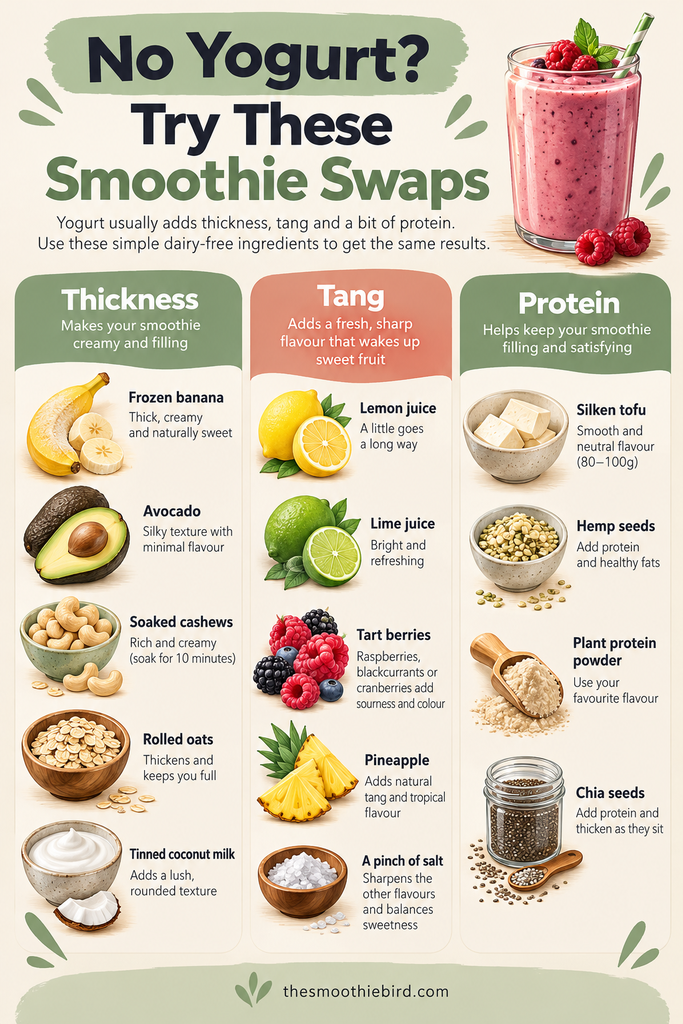
The good news is that yogurt only does three jobs in a smoothie, and each one has an easy swap. Replace thickness, tang and protein separately and you get a smoothie that is properly creamy without a drop of dairy.
Below you will find the swaps, six tested flavour combinations and a troubleshooting guide for when a blend does not behave.
🥣 What Yogurt Actually Does in a Smoothie
Most people add yogurt on autopilot. It helps to know why, because then you can replace the job rather than hunt for a one-to-one substitute.
Yogurt brings thickness, because it is dense and cold. It brings tang, a gentle sourness that stops fruit tasting flat. And it brings a bit of protein, which makes a smoothie feel more filling.
People leave it out for plenty of reasons. Some avoid dairy, some are vegan, and some simply do not like the taste.
If you want the basics of dairy-free blending first, start with our guide on how to make a dairy-free smoothie. This post goes one step deeper and tackles the “no yogurt and still creamy” problem.
🍌 Creaminess Swaps That Actually Work
Thickness is the job people worry about most. These ingredients all do it well, and each has its own personality.
- Frozen banana: the classic. It makes a smoothie thick and a little sweet, so you can often skip added sugar.
- Avocado: a quarter to half gives a silky, rich texture with almost no flavour of its own. Our post on adding avocado to smoothies covers it in more detail.
- Silken tofu: it blends into something very smooth and neutral. Use 80 to 100g per serving. It contains soy, so skip it if that is a problem.
- Soaked cashews: the closest thing to cream. Soak 30g in just-boiled water for 10 minutes, drain, then blend.
- Cashew or other nut butter: one tablespoon adds body and a toasty flavour.
- Rolled oats: 30 to 40g thickens a smoothie and keeps it filling. Blend well so it is not gritty.
- Tinned coconut milk: 60ml of the full-fat kind gives a lush, rounded texture.
- Chia seeds: a tablespoon thickens a smoothie as it sits, because the seeds swell in liquid. You can find chia seeds here if your cupboard is empty.
You rarely need more than one or two of these. A frozen banana plus a spoonful of cashew butter is already plenty.
🍋 Getting the Tang Back
Without yogurt, a smoothie can taste a little sweet and a little sleepy. A sharp note wakes it up.
Lemon or lime juice is the easiest fix. Start with one teaspoon and taste, because a little goes a long way.
Tart frozen berries such as raspberries, blackcurrants or cranberries add sourness and colour at the same time. Pineapple does a similar job in tropical blends.
A pinch of salt also helps, oddly enough. It sharpens the other flavours so the smoothie tastes more rounded.
🥤 Six Dairy-Free Smoothies Without Yogurt
Each recipe makes one large glass, or two small ones. All quantities are metric, and every ingredient is easy to find in a UK supermarket.
Use frozen fruit wherever the recipe says so. It chills the smoothie and thickens it without ice, which would water everything down.
A good blender makes all the difference with oats, nuts and seeds. A high-powered blender will turn them silky, while a weaker one may leave bits.
Berry Lemon Tofu Smoothie
This one is bright, pink and properly thick.
- 150g frozen mixed berries
- 80g silken tofu
- 1/2 frozen banana
- 200ml unsweetened oat or almond drink
- 1 tsp lemon juice
- 1 tsp maple syrup (optional)
Add the liquid first, then the tofu, fruit and lemon juice. Blend for 45 to 60 seconds until completely smooth.
Taste it before adding the maple syrup. Sweet berries often do not need it.
Peanut Butter Banana Oat Smoothie
This is the one for breakfast on a busy morning.
- 1 large frozen banana
- 1 tbsp smooth peanut butter (about 15g)
- 30g rolled oats
- 250ml unsweetened oat drink
- Pinch of cinnamon
Blend the oats with the liquid first for 20 seconds. Then add everything else and blend until thick and creamy.
If you want it thicker still, use a banana that has been frozen in chunks and add a splash less liquid.
Green Avocado Lime Smoothie
Do not be put off by the colour. It tastes fresh and tropical rather than “green”.
- 1/2 ripe avocado (about 70g)
- 40g fresh spinach
- 100g frozen pineapple
- 1/2 frozen banana
- Juice of 1/2 lime
- 200ml cold water or coconut water
Blend the spinach with the liquid first so it breaks down fully. Then add the rest.
A ripe avocado is the secret. If yours is hard, save it for toast and use extra banana here. You can even freeze avocado for smoothies when you spot a bargain.
Chocolate Cashew Smoothie
This tastes like a milkshake and needs no ice cream.
- 30g raw cashews, soaked in just-boiled water for 10 minutes and drained
- 1 large frozen banana
- 1 tbsp cocoa powder
- 1 pitted Medjool date
- 250ml unsweetened oat drink
Blend the soaked cashews with the oat drink first until no grit remains. Add the rest and blend again.
The date gives a caramel sweetness. Swap it for a teaspoon of maple syrup if you prefer.
Pineapple Coconut Smoothie
Think piña colada, minus the rum and the yogurt.
- 150g frozen pineapple
- 60ml full-fat tinned coconut milk
- 100ml cold water
- 1 tbsp chia seeds
- Juice of 1/2 lime
Blend everything until smooth, then let it sit for two minutes. The chia will thicken it a little more.
Shake the tin of coconut milk well before you open it, as it separates in the can.
Vanilla Oat Smoothie
This is the gentlest recipe, which makes it a good place to start.
- 40g rolled oats
- 1 large frozen banana
- 250ml oat drink
- 1/2 tsp vanilla extract
- 1 tbsp hemp seeds (optional)
- Pinch of cinnamon
Soak the oats in the oat drink for five minutes if you have the time. It makes the final texture noticeably smoother.
Our guide to oat milk smoothie recipes has more ideas if you want to build on this one.
🧮 A Simple Formula for Your Own Blends
Once you have made a few of these, you can stop following recipes. Use this loose formula instead and swap ingredients as the fridge allows.
Start with 250ml of liquid, such as oat, almond, soy or plain water. Add 150 to 200g of frozen fruit, with at least half of it something creamy like banana or mango.
Then choose one creamy booster from the swaps above. Finish with one sharp note, a teaspoon of citrus juice or a handful of tart berries, and sweeten only if you need to.
Blend the liquid and any hard ingredients first. Fruit goes in last, which stops the blades spinning in an air pocket.
This works because it mirrors what yogurt did in the first place. You are simply choosing each job yourself rather than getting all three in one scoop.
Keep a note of combinations you love. Over a few weeks, you will build a personal set of go-to blends that never need a tub of anything.
🌰 A Note on Nut and Soy Allergies
Several of these recipes use cashews, peanut butter or tofu. If you or anyone you are serving has a nut or soy allergy, check each ingredient label carefully.
For a nut-free version, use sunflower seed butter in place of peanut or cashew butter. Swap the cashews in the chocolate recipe for an extra half banana and a tablespoon of oats.
For a soy-free version, replace the tofu in the berry smoothie with a quarter of an avocado.
Always check packaging for “may contain” warnings, especially on oats and cocoa.
💪 Protein Without Yogurt, Honestly
Yogurt does add a little protein, but it is not a huge source in a typical smoothie. If protein matters to you, there are better routes than worrying about the tub.
Silken tofu, hemp seeds and nut butters all contribute something. None of them is a protein powerhouse on their own, so be realistic about what a handful of seeds will do.
A scoop of plant protein powder is the most reliable way to boost a smoothie. A plant protein blend works well in the chocolate and peanut butter recipes, where the flavour hides any earthiness.
We compare the options in our UK guide to protein powder for smoothies. If you would rather skip powder altogether, try our ideas for high-protein smoothies without powder.
🔧 Troubleshooting: When Your Smoothie Goes Wrong
Even a good recipe can misbehave. Here is how to fix the usual problems.
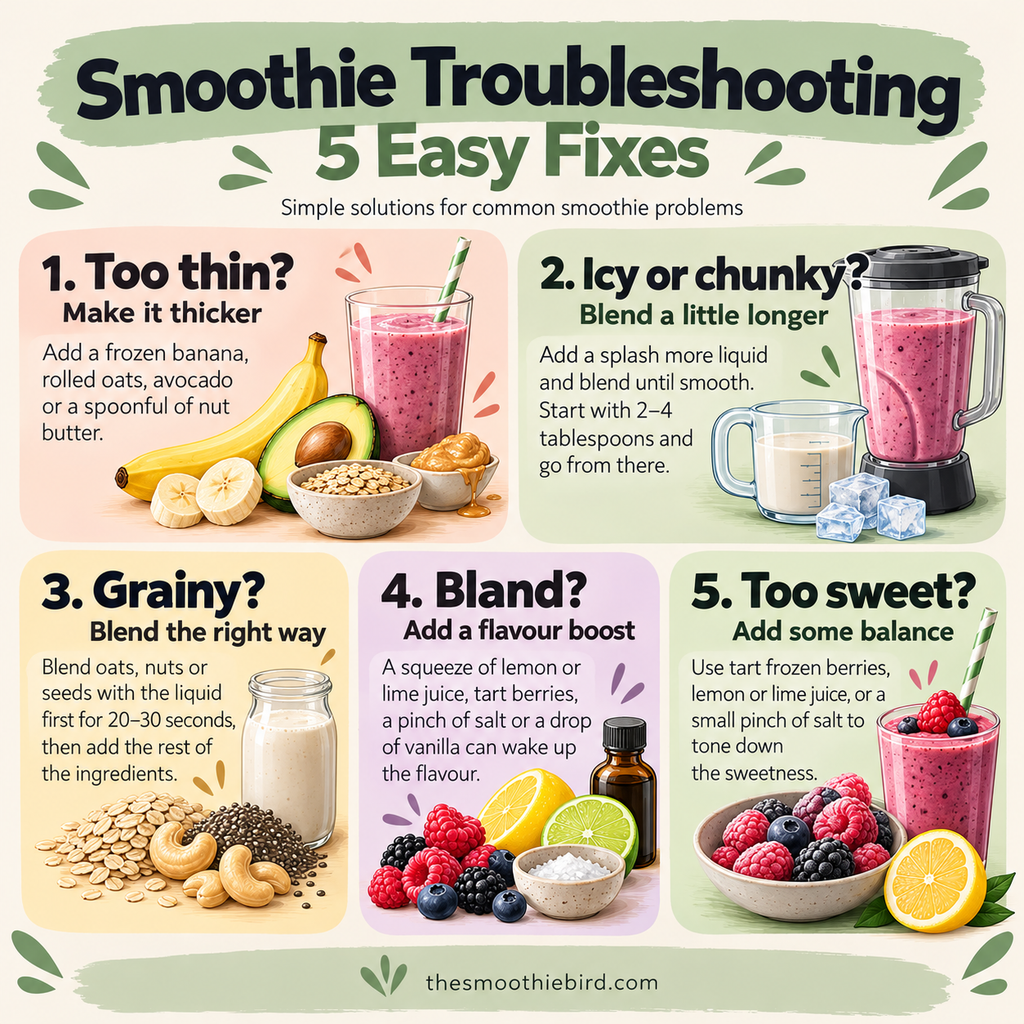
Too thin. Use more frozen fruit or less liquid. Add half a frozen banana, a tablespoon of oats or a spoonful of chia and blend again.
Icy or chunky. You have probably used too much ice or fruit straight from the freezer. Add a splash of liquid, let the blender run for another 30 seconds, and let the fruit sit for a couple of minutes next time.
Grainy. Nuts, oats and seeds are the usual culprits. Blend them with the liquid first, and soak cashews before using them.
Bland. Add a teaspoon of lemon or lime juice, a pinch of salt or a little vanilla. Taste, adjust, repeat.
Too sweet. Cut the banana by half and add something tart, such as frozen raspberries.
For more fixes, see our full guide to common smoothie texture problems.
🧊 Make-Ahead Freezer Packs
These smoothies are ideal for batch prep. Portion the frozen fruit, oats, seeds and any nuts into a bag, seal it and freeze.
In the morning, tip the bag into the blender, add your liquid and blitz. Keep any tofu, avocado or fresh spinach for the day itself rather than freezing them in the pack.
Reusable freezer bags are handy because you can fill, label and stack a week’s worth at once.
Our post on freezer smoothie packs walks through the process step by step.
❓ Quick Questions
Can I use dairy-free yogurt instead? You can, but this post skips yogurt altogether, including plant-based versions. The swaps above do the same three jobs without it.
Which milk works best? Oat gives the creamiest result, while almond is lighter. Our guides to oat milk and almond milk smoothies go through both, and milk in smoothies compares the lot.
Do I need to use frozen fruit? Frozen fruit gives the best texture. If you only have fresh, add a few ice cubes or freeze the banana first.
Can I make a mango one? Yes, and we already have a great one. Try our easy mango smoothie with no yogurt needed.
🌟 Final Thoughts
A creamy, dairy-free smoothie without yogurt comes down to three small decisions. Choose something for thickness, add something sharp for tang, and boost protein only if you need to.
Start with the vanilla oat or the peanut butter banana recipe, then move on to the more adventurous blends. Once you know what each ingredient does, you can improvise with whatever is in the freezer.


