Can You Make a Smoothie in a Food Processor? The Complete Guide
If you’ve got a food processor sitting on your counter and no blender in sight, you’ve probably wondered whether you can just chuck your smoothie ingredients in there instead. The short answer is yes, you absolutely can. The slightly longer answer is that it takes a bit of technique to get a texture you’ll actually enjoy drinking (or eating with a spoon).
As an Amazon Associate, I earn from qualifying purchases and sometimes recommend products from other sellers at no extra cost to you. For more details see my disclosure policy and privacy policy.
This guide walks through exactly how to do it, what results to expect, and how to fix things when your smoothie turns out lumpy instead of creamy. We’ll also look at which food processors handle smoothies best and when it might be worth upgrading to a dedicated blender.
Food Processor vs Blender: What’s Actually Different
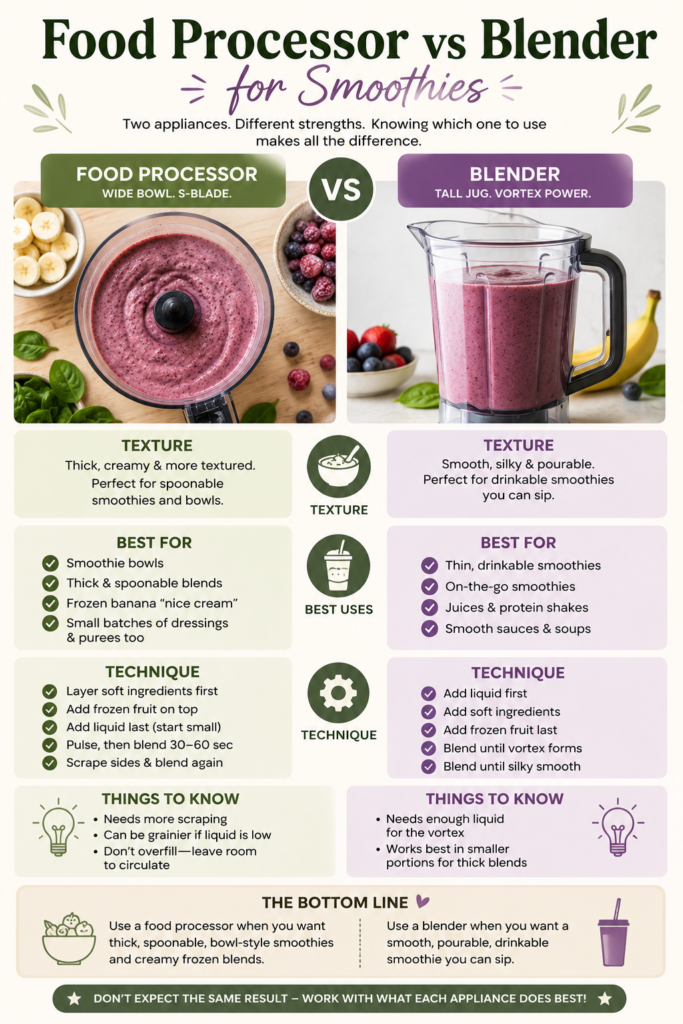
Blenders and food processors are built for different jobs, and that’s the whole reason this question comes up so often. A blender uses a tall, narrow jug and blades designed to pull liquid down through a vortex, which is exactly what you need for something smooth and drinkable.
A food processor uses a wide, shallow bowl with an S-shaped blade that’s built for chopping, slicing, and mixing solid food. It’s brilliant for pastry, hummus, and chopping vegetables, but it wasn’t designed to spin liquid into a vortex the way a blender is.
That doesn’t mean it can’t handle a smoothie. It just means the result will usually be thicker and a little more textured than what you’d get from a powerful blender. Think of it this way: a blender is for things you can drink or drizzle, and a food processor is for things you can eat with a fork or spoon. Once you accept that a food processor smoothie leans more towards spoonable than sippable, you’ll stop expecting the wrong result and start working with what the appliance actually does well.
Step-by-Step: How to Make a Smoothie in a Food Processor
Getting a good result is mostly about layering your ingredients correctly and being patient with the blending time. Here’s the method that works best:
- Fit the S-blade into the bowl before adding anything else
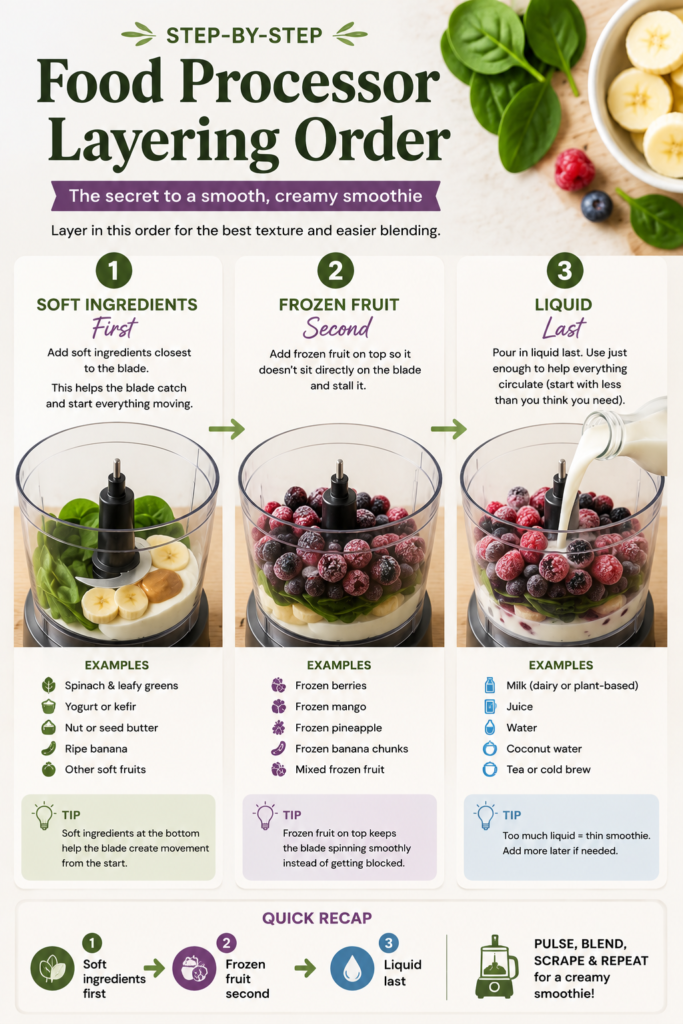
- Add soft ingredients first, closest to the blade — think spinach, yoghurt, nut butter, or ripe banana
- Add frozen fruit on top rather than at the bottom, so it doesn’t sit directly on the blade and stall it
- Pour in your liquid last, using just enough to help everything circulate (start with less than you think you need)
- Pulse a few times first to break everything down before switching to continuous blending
- Run for 30 to 60 seconds, then stop and scrape down the sides with a spatula
- Blend again for 15 to 30 seconds until the mixture looks creamy rather than chunky
The scraping step matters more than people expect. Because the bowl is wide and shallow, ingredients near the edges can sit untouched while the middle gets pulverised, so a couple of scrape-and-blend cycles usually makes the difference between a decent smoothie and a disappointing one.
If your model has a smaller mini-chopper attachment, that’s genuinely fine for herbs, dressings, or small batches, but it’s not going to cope with a full smoothie portion. Stick to the main bowl and blade for this.
Why Your Smoothie Turns Out Lumpy (And How to Fix It)
A grainy or lumpy food processor smoothie almost always comes down to one of a few common issues, and each one has an easy fix.
- Too little liquid — add a splash more milk, juice, or water so the mixture can actually move
- Too much frozen fruit at once — reduce the batch size or let a portion of your frozen fruit soften for a couple of minutes first
- Running continuously instead of pulsing — short pulses break down large chunks more effectively than one long blend
- Not scraping down the sides — stop halfway through and push everything back towards the blade
- Overfilling the bowl — smoothies need room to circulate, so don’t fill past the recommended maximum line
If you’re a regular over on our smoothie texture troubleshooting guide, a lot of the same fixes apply here too, since grainy texture is one of the most common smoothie complaints regardless of which appliance you’re using.
When a Food Processor Is Actually the Better Choice
Here’s the twist a lot of guides miss: for certain smoothies, a food processor genuinely outperforms a blender. Anything thick, spoonable, or bowl-based — frozen banana “nice cream,” mango sorbet-style blends, or a proper smoothie bowl — tends to come together better in a processor because it doesn’t rely on liquid movement the way a blender does.
If your goal is a thin, drinkable smoothie you can sip through a straw on the way out the door, a blender wins every time. But if you’re making a smoothie bowl loaded with toppings, a food processor’s ability to hold a thick, scoopable consistency without turning to soup actually works in your favour.
Best Food Processors for Smoothie-Curious Cooks
If you’re shopping for a food processor with smoothies in mind, a few features make a real difference: a wide feed tube and bowl capacity of at least 2 litres, a powerful motor (look for 600 watts or more), and an S-blade rather than just slicing discs.
- Sage (Breville) food processors tend to handle purees and thicker blends more smoothly than budget models, thanks to stronger motors
- Cuisinart’s larger capacity processors are a solid middle ground for anyone who wants everyday food prep with the occasional smoothie thrown in
- KitchenAid’s 13-cup processor has enough power and bowl space to manage a full smoothie portion without overworking the motor
If you already own a food processor and it’s coping fine, there’s no rush to replace it. But if you’re comparing options, these are the styles worth looking at rather than the smallest, cheapest models on the market.
Do You Need Both a Food Processor and a Blender?
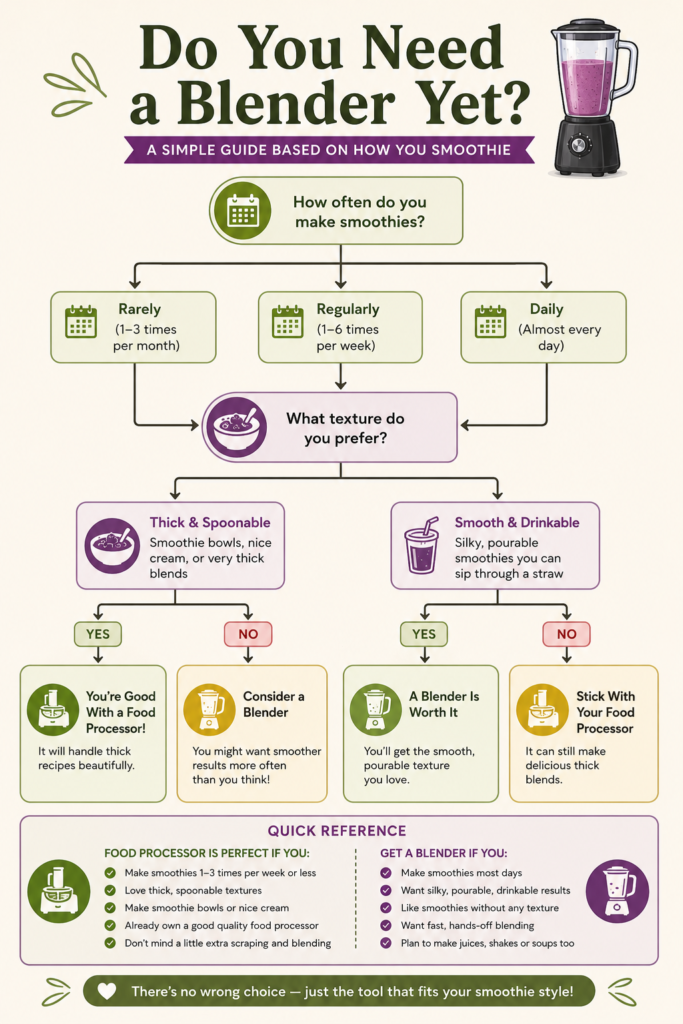
Honestly, it depends on how often you’re making smoothies. If it’s an occasional thing, your food processor can absolutely handle it using the method above, and there’s no need to buy another appliance just to sit on your counter.
If you’ve found yourself making smoothies daily, want a silkier texture, or you’re adding fibrous greens and seeds that need serious power to break down, that’s usually the sign you’ve outgrown what a food processor can comfortably do. At that point, a dedicated blender becomes worth the investment, and it’s worth reading through our guide to the best smoothie blenders to see which models are actually worth the money rather than guessing.
Some households solve this with a combo appliance that switches between food processing and blending attachments, which can be a smart middle ground if counter space or budget is tight.
How to Store Leftover Food Processor Smoothies
If you’ve made more than you can drink in one sitting, you can absolutely save the rest. Pour it into an airtight container and pop it in the fridge, where it’ll keep well for about a day before the texture and flavour start to decline.
For longer storage, freezing works too, though you’ll need to give it a proper stir or a quick re-blend once thawed, since food processor smoothies can separate more than blender smoothies do. Our smoothie storage guide covers the details if you want to batch-prep for the week ahead.
Frequently Asked Questions
Can I make a smoothie in a food processor, or do I really need a blender? You can absolutely make a smoothie in a food processor. It’ll be thicker and slightly more textured than a blender smoothie, but with the right technique — layering ingredients properly and scraping down the sides — you’ll get a genuinely good result.
Why is my food processor smoothie grainy compared to my old blender? This usually comes down to liquid ratio and blending technique rather than the appliance being incapable. Add a bit more liquid, pulse before running continuously, and scrape the sides at least once during blending.
Can a mini chopper handle smoothies, or is that just for herbs and onions? Mini choppers are better suited to small jobs like herbs, garlic, or dressings. For a full smoothie portion, you’ll get a much better result using the main food processor bowl and blade.
Is a food processor better than a blender for smoothie bowls? For thick, spoonable smoothie bowls, yes, a food processor often does a better job because it holds a thicker consistency without needing extra liquid to keep things moving.
When should I upgrade from a food processor to a proper smoothie blender? If you’re making smoothies daily, want a smoother texture, or you’re regularly adding fibrous greens and seeds, that’s a good sign it’s worth investing in a dedicated blender.
Continue Your Journey
- How to Easily Freeze Fruit for Your Smoothies — get your frozen fruit prepped properly so it blends smoothly instead of stalling your food processor
- Banana Apple Protein Smoothie — a great recipe to try out with your new food processor technique
- Best Smoothie Powder Supplements UK — pick a protein powder that blends well without going gritty in a food processor
- Smoothie vs Milkshake: Which Is the Better Choice? — if you’re after something thicker and more indulgent, this one’s worth a read


