The Milk Alternatives Hub: Best Non-Dairy Milks For Smoothies (With Recipes)
Oat, almond, coconut, soy, cashew, rice, pea — walk down the milk aisle today and it’s less a shelf, more a small negotiation. Every one of them will work in a smoothie, but they don’t all work the same way, and picking blind is how you end up with a green smoothie that tastes like dessert or a “creamy” blend that separates in the glass. This guide breaks down what each milk alternative actually does once it hits the blender, who it suits, and gives you a recipe to test it with — so the next carton you buy is a choice, not a guess.
As an Amazon Associate, I earn from qualifying purchases and sometimes recommend products from other sellers at no extra cost to you. For more details see my disclosure policy and privacy policy.
Why milk alternatives matter in smoothies
There are a dozen reasons you might be standing in front of the fridge wondering what to pour into your blender instead of dairy milk. Maybe you’re lactose intolerant, maybe you’re eating more plant-based, maybe you’re just trying to cut down on calories without cutting out the smoothie habit, or maybe you simply ran out of milk and found three cartons of oat, almond and soy staring back at you from the cupboard. Whatever brought you here, the good news is simple: almost any milk alternative works in a smoothie, and once you know how each one behaves, you can pick on purpose instead of by accident.
“Milk” in this context covers a lot of ground — dairy, oat, almond, coconut, soy, and half a dozen others most people have never tried. This hub focuses squarely on the alternatives: what each one actually does to your smoothie’s texture and flavour, who it tends to suit best, and how to swap it into a recipe without any trial and error. Think of it as the reference you keep coming back to rather than a one-off read.
This hub covers the main non-dairy milks people reach for — oat, almond, coconut, soy, and a few less common options — with a quick recipe for each so you can taste the difference for yourself, not just read about it.
How to choose the right smoothie milk alternative
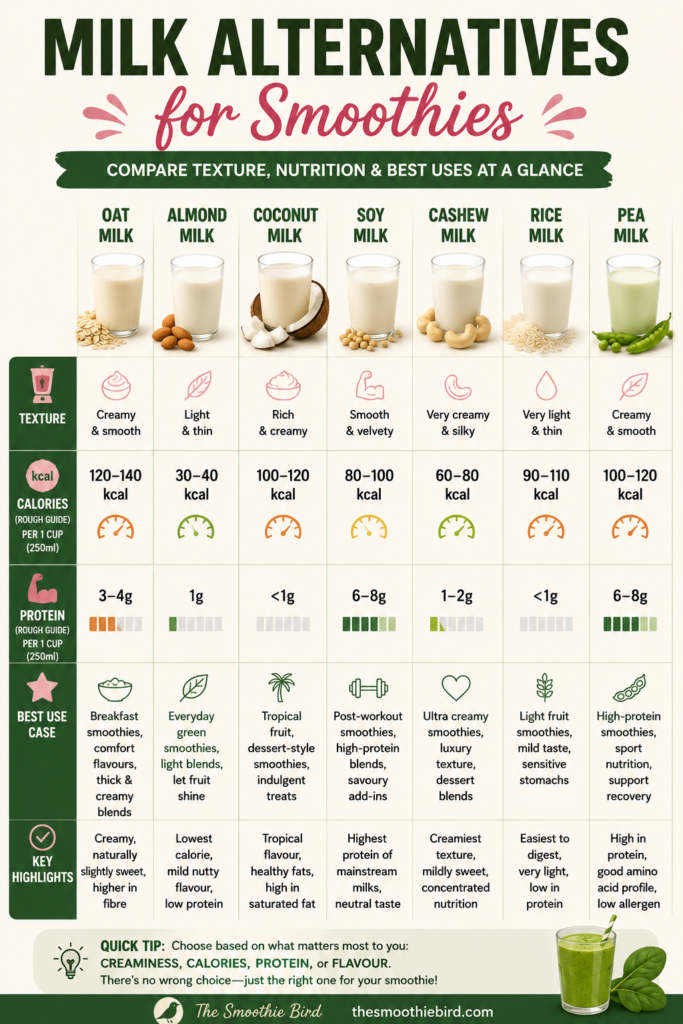
Before you commit to a carton, it helps to think about four things: texture (do you want thick and creamy or light and easy-drinking?), flavour (neutral background or something with its own personality?), nutrition priority (protein, fibre, or just fewer calories?), and dietary needs (nut-free, soy-free, or watching added sugar?).
Here’s the short version before we go section by section:
- Oat milk – creamy, naturally a little sweet, great for thick breakfast smoothies.
- Almond milk – light, nutty, lower calorie, a solid everyday base.
- Coconut milk – rich and tropical, best saved for dessert-style or indulgent blends.
- Soy milk – higher protein, fairly neutral flavour, a smart pick post-workout.
- Cashew, rice, and pea milk – smaller niches worth knowing about, covered further down.
The Smoothie Bird
Which Smoothie Milk Matches You?
4 quick questions, one milk recommendation, and a recipe to try tonight.
Oat, almond, coconut or soy? Answer four quick questions about texture, dietary needs, flavour mood and what you actually want out of your smoothie — we’ll match you with the milk (and recipe) that fits.
- 🕐 Takes about 30 seconds
- 🥣 Get one milk pick + a recipe to try
- 🔁 Retake anytime — there’s no wrong answer
Oat milk in smoothies
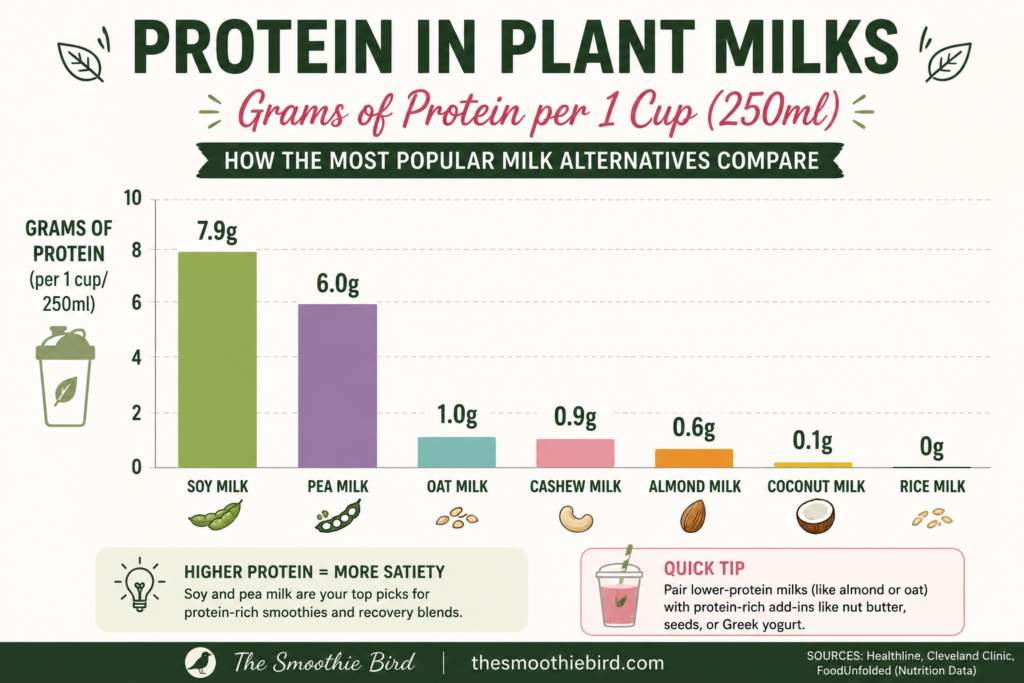
Oat milk has become the default “safe bet” for a reason. It’s naturally creamy with a mild sweetness, and it tends to be higher in soluble fibre than most other plant milks, which is part of what gives it that silky mouthfeel. The trade-off is that it’s usually more carb-heavy than nut-based milks, and some brands add a noticeable amount of sugar, so it’s worth glancing at the label if that matters to you.
Best for: breakfast smoothies and comfort flavours — think banana, cinnamon, oats, nut butter.
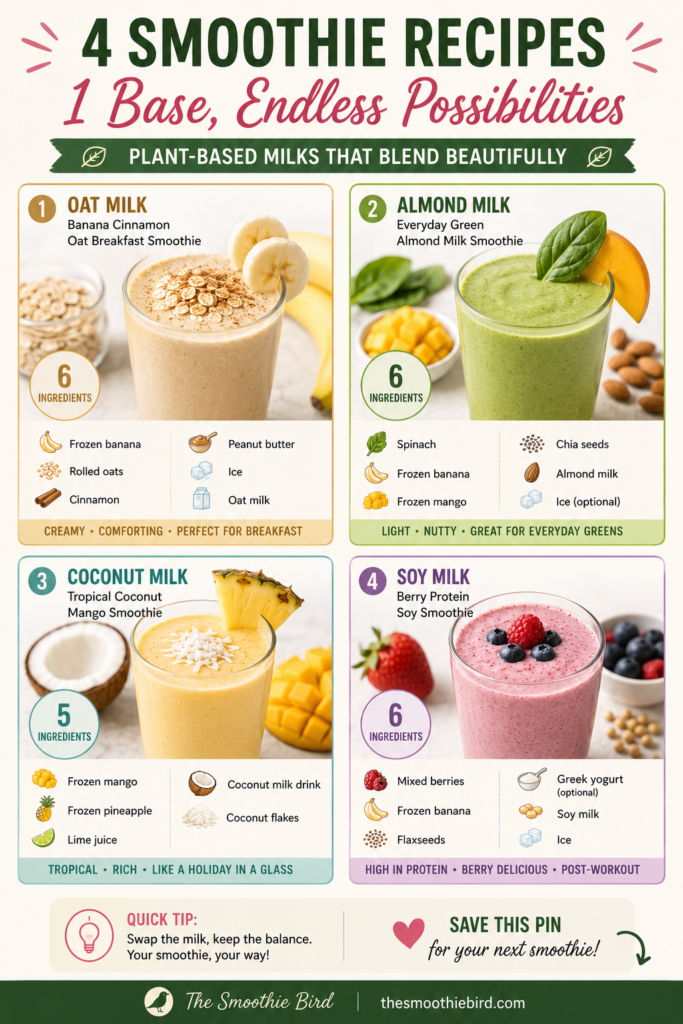
Try it: Banana Cinnamon Oat Breakfast Smoothie
- 250ml oat milk
- 1 frozen banana
- 1 tbsp rolled oats
- ½ tsp cinnamon
- 1 tbsp peanut butter
- Handful of ice
Blend until smooth. The oats add a bit of extra body if you like your smoothies thick enough to eat with a spoon.
Shopping note: barista-style oat milks (formulated to froth) tend to blend even creamier than the standard carton, so it’s worth having one on hand if oat is your everyday choice.
Almond milk in smoothies
Unsweetened almond milk is one of the lightest options on this list — plain, unsweetened varieties often come in under 40 calories a cup — which makes it an easy everyday base if you’re watching calories or just prefer a smoothie that doesn’t feel heavy. It’s got a mild, nutty flavour that gets out of the way of fruit and greens rather than dominating them. The trade-off is protein: almond milk is naturally low in it, and it’s obviously off the table if you’re cooking for someone with a nut allergy.
Best for: everyday green smoothies, calorie-conscious blends, anything where you want the fruit to be the star.
Try it: Everyday Green Almond Milk Smoothie
- 250ml unsweetened almond milk
- 1 large handful spinach
- ½ frozen banana
- ½ cup frozen mango
- 1 tsp chia seeds
Blend until fully smooth — the mango does most of the work masking the spinach for anyone easing into green smoothies.
Shopping note: unsweetened is worth seeking out specifically here — the vanilla and sweetened versions can tip a “healthy” green smoothie into dessert territory without you realising.
Coconut milk in smoothies
Worth splitting into two camps here: tinned coconut milk (thick, rich, mostly used in cooking) and the carton “coconut milk drink” you’ll find in the chiller aisle, which is much lighter and closer to a standard milk alternative in texture. For smoothies, the carton version is usually the easier starting point — tinned works but you’ll likely want to thin it with water or another liquid.
Coconut milk brings genuine tropical richness and healthy fats, but it’s also the highest in saturated fat of the milks on this list, so it tends to work best as an occasional treat option rather than an everyday base.
Best for: tropical fruit smoothies, dessert-style blends, weekend indulgence rather than the Tuesday-morning rush.
Try it: Tropical Coconut Mango Smoothie
- 250ml carton coconut milk drink
- 1 cup frozen mango
- ½ cup frozen pineapple
- Squeeze of lime
- Handful of ice
Blend until smooth and serve like you’re on holiday, even if you’re just at the kitchen counter.
Shopping note: check the label for “light” coconut milk drink if you want the flavour without quite as much fat — it’s a genuinely useful middle ground between tinned and the standard carton.
Soy milk in smoothies
If protein is your priority, soy milk is one of the strongest plant-based options available — most unsweetened varieties provide somewhere in the region of 7-9g of protein per cup, putting it much closer to dairy milk than almond, oat, rice or coconut milk manage. It’s also usually fortified with calcium, vitamin D and B12, and its flavour is fairly neutral, though it can read as slightly “beany” against very delicate fruits.
Best for: post-workout smoothies and breakfast blends where you want the protein to actually add up.
Try it: Chocolate Peanut Soy Protein Smoothie
- 250ml soy milk
- 1 tbsp cocoa powder
- 1 tbsp peanut butter
- 1 frozen banana
- Handful of ice
Blend until smooth. This one drinks more like a milkshake than a virtuous health drink, which is exactly the point.
Shopping note: organic and higher-protein soy milks are worth comparing on labels — protein content genuinely varies more between soy brands than it does for oat or almond.
Other plant-based milk alternatives worth knowing
You don’t have to stop at the big four. A few others are worth keeping in your back pocket, especially if you’re catering to different dietary needs across a household:
- Cashew milk – very creamy and mild, a good option if you want coconut-level richness without the coconut flavour. Works particularly well in dessert-style smoothies where you want a neutral, luxurious base.
- Rice milk – naturally sweet, very light, and one of the more allergy-friendly options since it’s typically both nut-free and soy-free. It’s thinner than most alternatives, so it benefits from a frozen banana or a spoon of oats for body.
- Pea milk – less common on UK shelves but worth seeking out if protein is your priority — it lands in a similar range to soy milk, around 8g per cup, with a fairly neutral taste. A good option for anyone avoiding both soy and nuts who still wants a protein-forward smoothie.
How to swap dairy milk for these alternatives
The good news: most smoothie recipes will take a 1:1 swap without much fuss. The nuance is in adjusting for texture and sweetness once you’ve made the switch.
- If your chosen milk is thinner than you’re used to (almond, rice), add banana, oats, or a spoon of nut butter to bring back some body.
- If it’s richer than dairy (coconut, cashew), you may want to dial back other fats in the recipe or use slightly less of it.
- Sweetened varieties of any plant milk can make a smoothie sweeter than expected — check the label before you add extra fruit or honey on top.
Practical tips: sweetness, thickness, and flavour
A few small adjustments make a bigger difference than people expect:
- Go easy on extra sweetener. Many plant milks are already sweetened, so taste before you reach for honey or syrup.
- Use ice, frozen fruit, oats, or chia seeds to control thickness depending on which milk you’re using — thinner milks benefit from a frozen boost.
- Match flavours on purpose: oat milk works beautifully with cinnamon, apple and banana; almond milk pairs well with berries, spinach and vanilla; coconut milk loves pineapple, mango and cacao; soy milk is a natural match for banana, cocoa and peanut butter.
If you’re still getting your base liquid choices right in general (not just milk alternatives), it’s worth reading our guide to picking the perfect smoothie liquid base alongside this one.
FAQ: smoothie milk alternatives
Can I make a smoothie without any milk at all? Yes — juice, coconut water, or even plain water all work as a liquid base, especially if you’re already using yoghurt or a creamy fruit like banana or avocado for body.
What’s the best milk substitute for a creamy smoothie? Oat, cashew, or full-fat coconut milk drink tend to give the creamiest results, since they’re naturally thicker than almond or rice milk.
Which milk alternative is best for weight-loss-focused smoothies? Unsweetened almond milk is usually the lightest option calorie-wise, but the bigger lever is almost always what else goes into the blender rather than the milk itself.
Are milk alternatives good for kids’ smoothies? Many families use them without issue, but if you’re making changes to a child’s diet for nutritional reasons, it’s worth a quick chat with a GP or dietitian rather than relying on a blog post — every child’s needs are different.
Do I need to buy a specific brand for smoothies, or does it matter which one I pick? It matters less than you’d think for flavour, but it matters more than you’d think for sugar content. Unsweetened, unflavoured versions of any milk alternative give you the most control — you can always add sweetness with fruit, but you can’t take it back out once it’s in a sweetened carton.
Which one should you actually buy?
Honestly, there’s no single “best” milk alternative for smoothies — just the one that fits what you’re making. If you want your Tuesday breakfast smoothie to actually keep you full, reach for oat or soy. If you want something light that gets out of the way of your fruit, almond is your friend. And if you’re making something that feels more like a treat than a meal, coconut earns its place. Pick a recipe above, give it a go, and adjust from there — that’s really the whole method.
If you haven’t already sorted out a fully dairy-free routine, our guide to building a dairy-free smoothie is a good next stop, and if your blends keep coming out grainy or too thin no matter which milk you use, our smoothie texture troubleshooting guide covers the fixes.